Claude Bolling and the Cinema: A Complete Filmography and Analysis of His Work
Claude Bolling, a leading composer in French cinema
Claude Bolling holds a unique place in the history of film music. A virtuoso pianist, prolific composer, and leading figure in European jazz, he has built a rich body of film work spanning nearly half a century.
From his early days in the 1950s through to major international productions, Claude Bolling established an instantly recognizable musical signature: elegance, melodic clarity, and a subtle fusion of jazz and classical composition.
Claude Bolling’s cinematic work serves as a bridge between jazz and cinema. It helped define a strong sonic identity for French cinema between the 1960s and 1980s.
His musical legacy remains a benchmark for lovers of film music and jazz today.
This page offers a complete filmography, enriched with an analysis of his style and major collaborations.
A unique approach to film music
Unlike many composers of his generation, Claude Bolling does not limit himself to the symphonic tradition. He developed a hybrid approach based on three pillars:
-
a compositional style rooted in jazz (swing, improvisation, rhythm)
-
a rigor inherited from classical music
-
an ability to serve cinematic storytelling
This approach allows him to work on:popular comedies
-
crime films
-
international productions
-
animated films
His style became particularly recognizable in the 1970s, a period during which he collaborated with major directors such as Jacques Deray and Philippe de Broca.

Complete filmography of Claude Bolling
The Early Years
(1950s)
Claude Bolling's early works span a wide range of formats, with a strong emphasis on short films.
1952 – Autour d'une Trompette (court-métrage) – Pierre Neurisse
1955 – Oh Que Mambo – John Berry
1955 – Bonjour Cinéma – Jean Guillon
1957 – Joies de Cannes – René Vautier
1957 – Paris à la Manière de... – Jacques Thierry
1957 – Pourvu qu'on ait l'Ivresse – Jean-Daniel Pollet
1957 – Cette Nuit-Là – Maurice Cazeneuve
1959 – La Ligne de Mire – Jean-Daniel Pollet
At this stage, Bolling was already experimenting with a highly narrative style of composition.
The Emergence
(1960s)
In the 1960s, Claude Bolling began to make a name for himself in the French film industry.
1960 Les Mains d'Orlac - Edmond T. Greville
L'Homme à Femmes - Jacques-Gérard Cornu
De Noé à Zoé (animation) - L. Berthon/Y. Mutschler
1961 Vendredi Treize Heures - Alvin Rakoff
1963 Le Jour et l'Heure - René Clément
Les Aventures de Salavin - Pierre Granier Deferre
Constance aux Enfers - François Villiers
1965 Typhon sur Hambourg - Alfonso Balcazar
Moi et les Hommes de 40 Ans - Jack Pinoteau
1967 Du Mou dans la Gâchette - Louis Grospierre
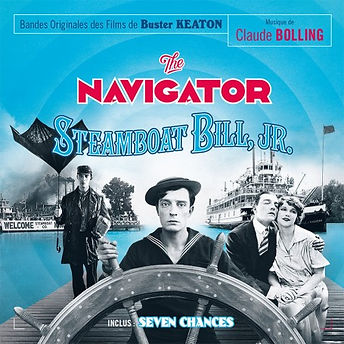
In 1968, he also undertook an original project on Buster Keaton’s silent films, composing new scores for several of them.
The Navigator
Steamboat Bill Jr.
Seven Chances
The Golden Age
(1970s)
The 1970s marked the peak of his film career.
Among major works:
Borsalino – Jacques Deray
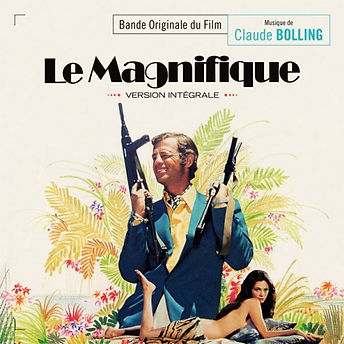
Le Magnifique – Philippe de Broca
Flic Story – Jacques Deray
Le Gitan – José Giovanni
L’Année Sainte – Jean Girault
Le Gang – Jacques Deray
La Ballade des Dalton – with René Goscinny
1970 La Baille (court-métrage) - Jean Reynaud
Qui - Leonard Keigel
Le Mur de l'Atlantique - Marcel Camus
1971 Doucement les Basses (CD) - Jacques Deray
On est toujours trop bon avec les Femmes - Michel Boisrond
Catch me a Spy (Les Doigts croisés) - Dick Clément
La Grande Mafia - Philippe Clair
Daisy Town / Lucky Luke (CD)- Morris et Goscinny
1972 La Mandarine (CD)- Edouard Molinaro
Le Magnifique (CD)- Philippe de Broca
1973 Quand c'est parti, c'est parti - Denis Heroux / Gilles Richer
1974 Dites le avec des Fleurs - Pierre Grimblat
Borsalino & Co - Jacques Deray
Deux grandes Filles dans un Pyjama - Jean Girault
Dis-moi que tu m'aimes (CD)- Michel Boisrond
1975 Vous ne l'emporterez pas au Paradis - François Dupont-Midy
Au Bal de Neptune (court-métrage) - Jean Reynaud
Il faut vivre dangereusement - Claude Makowski
Flic Story (CD) - Jacques Deray
1976 L'Année Sainte (CD)- Jean Girault
L'Ordinateur des Pompes Funèbres - Gérard Pires
Les Passagers (CD)- Serge Leroy
Le Gang - Jacques Deray
1977 Silver Bears - Ivan Passer
Le Mille-Pattes fait des Claquettes (CD) - Jean Girault
1978 La Ballade des Dalton / Lucky Luke (CD) - Morris et Goscinny
Un Papillon sur l'Epaule (CD) - Jacques Deray
L'Horoscope - Jean Girault
International Expansion
(1980s)
Claude Bolling has worked on several English-language productions and expanded his audience. His style has evolved while retaining a strong European identity.
1979 California Hotel (California Suite) (DVD Zone 1) - Herbert Ross
The Mouth of the Other - Pierre Tchernia
The Angry Man ( CD ) - Claude Pinoteau
1980 The Awakening (Curse of the Valley of the Kings) ( CD ) - Michael Newell
Watch out for Lagaffe - Paul Boujenah
1981 Three Men to Be Slaughtered ( CD ) - Jacques Deray
A wonderful day - Claude Vital
Willie and Phil - Paul Mazursky
1982 La Revanche ( CD ) - Pierre Lary
The Poacher of God - Jean-Pierre Darras
1983 Louisiana - Philippe de Broca
1984 The Leopard ( CD ) - Jean-Claude Sussfeld
The Bay Boy - Daniel Petrie
1985 One only dies twice - Jacques Deray
1986 La Gitane ( CD ) - Philippe de Broca
1987 La Rumba - Roger Hanin
1989 Save Your Respect ( CD ) - Guy Hamilton
Last years
(1990)
1991 Netchaev is back - Jacques Deray
Plaisir d'Amour - Nelly Kaplan
1998 Chances or Coincidences (with Francis Lai) - Claude Lelouch
The iconic films of Claude Bolling's career as a composer.
Claude Bolling has composed more than 100 scores for French and international films. From Buster Keaton to Jacques Deray, Philippe de Brocca, and Jean Girault, discover the iconic collaborations that have marked his career.


The Characteristics of the Bolling Style in cinema
Claude Bolling’s musical style is characterized by several distinctive elements:
1. A strong jazz influence: swing, syncopated rhythms, and typical instrumentation (piano, brass).
2. Accessible melodic writing: Unlike some more experimental film scores, Bolling favors memorable themes.
3. Elegant orchestration: Masterful use of the orchestra, without overloading it.
4. Great adaptability: Ability to compose for comedies, crime films, historical films, and animation.
